A New Era for Philanthropy?

By Maria Amalia Souza, CASA Socio-Environmental Fund
If you are a social actor from the Global South, you may have already asked yourself if conventional philanthropy isn’t possibly missing the beat of changes in our societies. While the field has undoubtedly been key to helping develop important elements of the social movements in our region, some fixed habits and established procedures seem not to follow the new times, and continue to leave us out of the decisions on how funding is allocated in our countries. Philanthropic publications and networks have consistently urged philanthropy to acknowledge that our work can be more effective, resources better and more cost-effectively used, if local groups and communities have a say in how they are spent. Many articles urge Northern funders to become more participatory and inclusive in their procedures, to involve, consult and listen to the vulnerable and excluded communities they aspire to support. But, with the best of intentions, how much can a structure based in the Northern hemisphere do, when it is not part of the societies and systems it is hoping to improve?
For many years before developing the Casa Fund structure and systems of grantmaking, this was our main question: why don’t resources reach the most excluded and vulnerable communities in the vast and biodiversity-rich biomes and ecosystems of the world? People of under-privileged communities everywhere, in rural areas or urban peripheries, in the remote mountains, deserts, forests or wetlands, are entirely excluded from the benefits of philanthropy, because they are just too hard to reach, and pretty much invisible to conventional funders. Even when some funders reach some of them — at most a handful of groups — it isn’t in a completely systemic way that can really affect local realities in a broad sense. In essence, community-based groups in remote regions are left out. They don’t know our field exists, so they are unable to ask for support.
With these considerations in mind, Casa Fund set out to create another way of distributing resources that uses a reverse logic from most structures. We asked ourselves two questions: (1) what needs to be done?, and only then, (2) what is the disbursement mechanism necessary to respond to the actual needs of these territories?
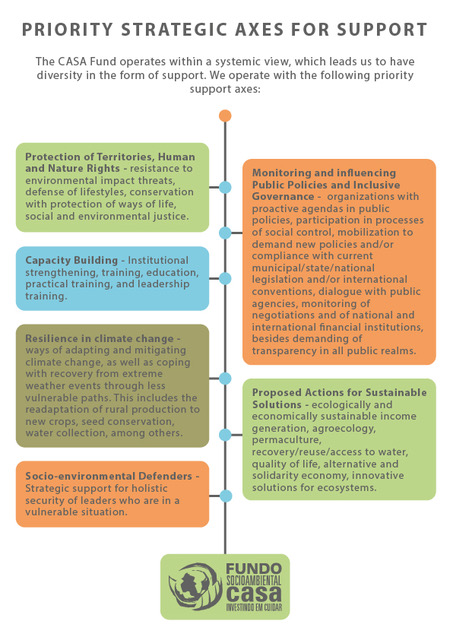
An important characteristic is that we, the founders of Casa Fund, are all actors in the socio-environmental field of South America —and the term socio-environmental is key here! We have always believed that people need to be full participants in the solutions to restoring, preserving and protecting life on earth. There are important integral biomes like forests and wetlands to be protected, but in truth, wherever people live, there are ways to act more responsibly — like improving food production methods, restoring soil and fresh water, protecting the oceans, improving life in the cities, and so on.
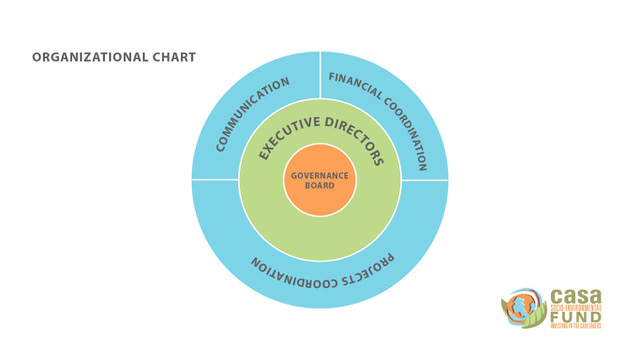
And being local actors, the last thing we wanted was for other social actors to see us as ‘the money holders’, the ‘gatekeepers’ to financial resources. So we needed to figure out a system that put the real importance elsewhere, not on the holders of cash, but in a system that recognized the true power is in the actions of people. Besides that, we needed everyone to know that there would be no gatekeepers at all, no one with power over the money — that distribution would be so transparent and objective that anyone could reach it when they were ready, with a system, of course, but a clear and accessible one.
Based on these principles, the Casa Fund started building upon the relationships we already had, and then more. For over 15+ years, we have developed a vast web of trust networks, made up of thousands of people, and their relationships, and on from there. Between our over 2000 grantees in 9 countries, plus the dozens of thematic and territory-focused networks, we have tapped into an incredibly rich source of wisdom and guidance. And we have developed a truly horizontal granting mechanism that avoids any individual or group having the power over how the money we raise is distributed.
Basically this is how it works:
- Casa Fund raises money from all kinds of different sources, national and international.
- Based on agreements with the funder, we develop a document with criteria and guidelines.
- A call for proposals is developed and shared throughout all our networks working on the themes and in the regions agreed upon by Casa and the funder – and the word is out!
- There are many of these calls during the year, shaped to different regions and public, according to the funds we are able to secure.
-
Once the call is out, a ‘ranking matrix’ is developed that assures that proposals received are aligned with the criteria we agreed with our funding partner.
A NOTE IS IN ORDER HERE: Foundations in general have always relied on the figure/expertise of program officers to help them select the best proposals to fund. Normally POs are hired for their expertise in their fields. They get allotted a portfolio (and corresponding funds) and the job to look for groups that fulfill these criteria. Casa Fund decided to use a different mechanism. We realized we needed “networkers” instead. Our staff is each responsible for coordinating one or two programs as agreed with our funders. Their main role is to inform our wide network of partners that resources are available for specific regions or themes. They gather responses and proposals that arrive, and process them according to our agreed contracts, criteria and matrix. The difference is that they don’t make any decisions on how money is allocated. They technically review each proposal and rank them to present to the team.
- So, proposals come in and are ranked. This ranking will have a cut-off line when the funds are used up. An Excel spreadsheet with summaries of who applied, what the proposal is, how it arrived in our hands, how much they correspond to the criteria developed in the beginning, and a personal recommendation by the reviewer, is prepared for conversations with the rest of the team (first) and then go for ratification of the Governing Board (second) who form our legal decision-making body. This board is made up of experienced leaders in all kinds of fields pertaining to Casa Fund’s mission. They help us understand the broader scenarios, the priority themes and regions, and serve as political stewards to the organization. We also have an Advisory Board which is convened when their expertise is needed.
- Contracts are prepared and the funds are transferred to each group. The team monitors development and analysis reports and the amazing stories of empowerment that come back.
Over the years, our funding partners have been growing in numbers and amount of funds committed. This year we will be donating almost US$5 million, a record for us. And we have also helped independent local socio-environmental funds to get started in seven other countries so far- Argentina, Paraguay, Bolivia, Colombia, Peru, Ecuador and Mozambique. All of them are local actors, who have dedicated their lives to their causes, who understand and share our philosophy of open-source social technology of grant-making — which we are making available to anyone interested anywhere in the Global South, East, West … and North, for that matter.
Maria Amalia Souza is Founder/Senior Advisor of CASA Socio-Environmental Fund. Her career of 35+ years specialized in designing strategies that assure philanthropic resources reach the most excluded grassroots groups working on social and environmental justice issues in the Global South. She is part of Human Rights Funders Network Steering Committee, and co-founder of the Brazil Philanthropy Network for Social Justice. Amalia has a degree in International Services/Development/Environmental Studies, and a fellowship in Systems Thinking from the Dana Meadows Sustainability Program. In 2016, Amalia was shortlisted for the Olga Alexeeva Memorial Prize on Innovative Philanthropy in the Global South.