Bridging Worlds: What Marajó Revealed About Climate Action and COP30
By Erika Miller, the Head of Climate at WINGS and Katrin Harvey, the Secretary General of the Foundations Platform F20.
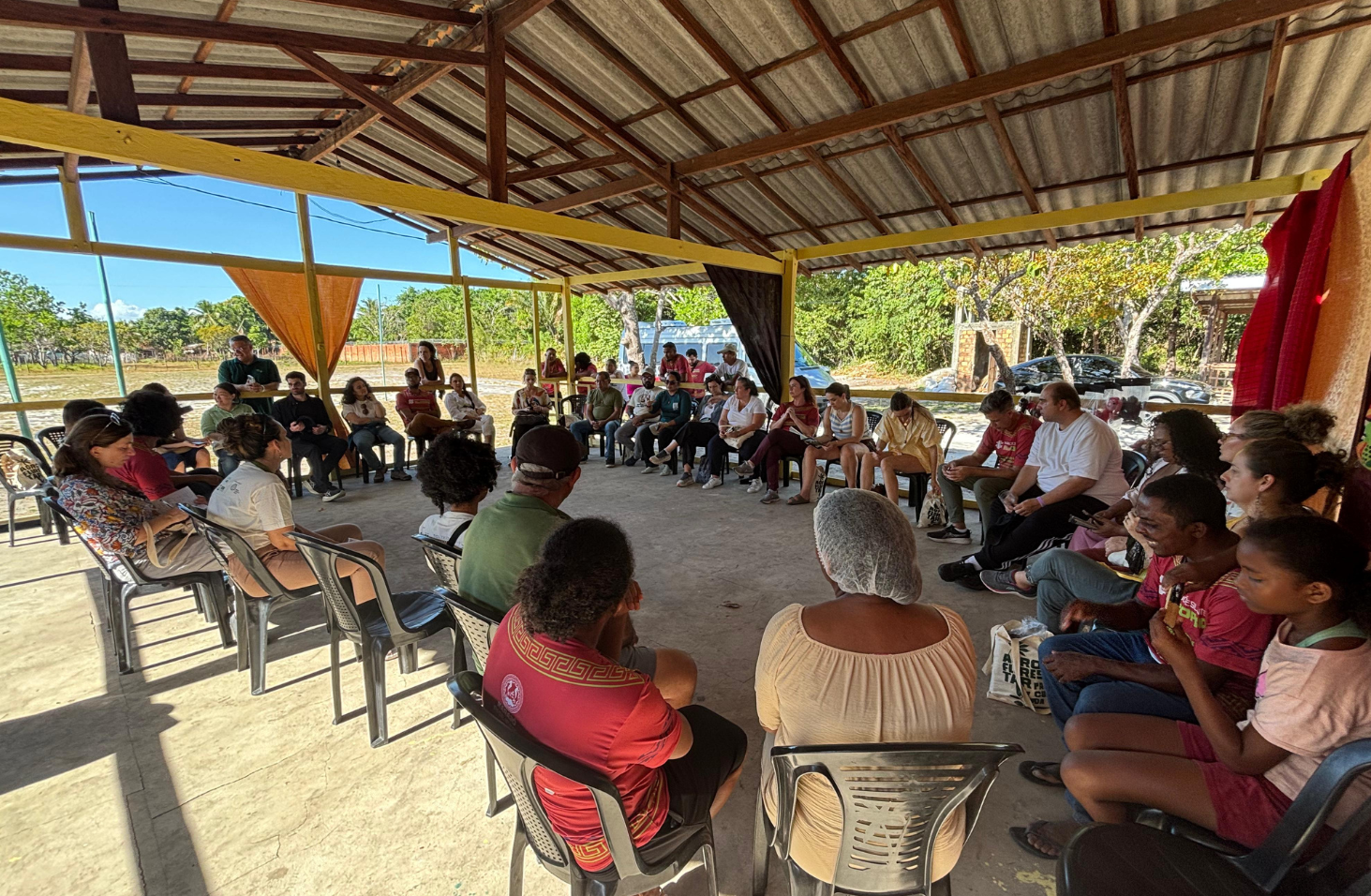
Marajó sits at the mouth of the Amazon, close to Belém, but it takes time to get there. Reaching the island requires a long, choppy boat ride that must be timed with the tides. We visited Marajó last year, alongside COP30 in Belém, moving between a place where climate impacts and responses are part of daily life, and the global spaces where those same issues are discussed and negotiated.
For both of us, coming from WINGS and F20, the visit felt important for a simple reason. We work as networks of networks and are therefore layers removed from the implementation of our sector’s work. We work with funders, who work with local partners, who work with communities. We hear about the work. We analyse it. We advocate around it. But we do not often get to see how it actually comes together over time, with the people involved.
Marajó gave us that perspective – and a visceral experience of how life feels like in the Amazon for the people protecting their livelihoods, adapting to climate change and doing what it takes to build community resilience. It was deeply grounding for the two of us.
What Marajó made clear is that climate action depends on connective roles: people and organisations that translate across levels, support peer learning, and stay engaged over long periods of time.
Making the chain visible
One of the things that stood out quickly was how visible the “chain” of climate action becomes on the ground, and how many actors are required to sustain progress over time. The Marajó Resiliente project we visited has been in development for several years. It involved community organisations, women’s associations, local leaders, philanthropic actors such as Avina, policy intermediaries like Connexus, and engagement with international funders like the Green Climate Fund, including global climate finance mechanisms.
Seen up close, it was clear that this was not one project in the narrow sense. It was the result of many different actors playing different roles over time. No single organisation was doing everything. Progress depended on sequencing, coordination, and people staying engaged through changes in context, policy, and leadership. It was a reminder that impact is rarely about one intervention, but about how many pieces fit together across a long timeline.
Bridging in practice
A lot of that work depends on bridging. Some of it is obvious. Neither of us speaks Portuguese, and we relied on translation throughout the visit. Not everything worked perfectly and yet we always felt completely included in the conversation, and closely connected to the people we met, not least thanks to the colleagues at Fundación Avina who often took on the role as our personal interpreters.
But the more challenging work was not linguistic. It was conceptual. One conversation that stayed with us was about “extractive practices.” In many global policy spaces, the term has a negative connotation. In Marajó, agroforestry practitioners use it to describe practices that involve harvesting by picking, rather than cutting, burning, or destroying plants. For them, it was one of the most sustainable ways of working with the land.
Understanding that difference required explanation and patience. It was a good reminder that words travel badly between contexts, and that meaning needs to be carefully translated, not assumed. Avina played that role repeatedly during the visit — connecting local actors with funders and helping people from very different systems understand each other. As Valéria Carneiro writes, “It is not just resource that moves our web, / It is the trust that weaves the steady net.” This kind of bridging work is often invisible in global conversations, yet it is essential to making climate action viable in practice.
Local leadership and peer learning
Katrin arrived in Marajó directly from the Local Leaders Forum in Rio, where 14,000 local and subnational leaders had come together to talk about climate implementation. The similarities between what we saw there and what we saw in Marajó were striking.
In both cases, proximity mattered. Local leaders are closer to their constituencies and to the positive impacts they are working towards. That shapes how decisions are made and how quickly they can be adjusted. We saw this in Marajó through women’s associations sharing information across communities, through local leaders learning from each other, and through individuals taking on informal roles as knowledge sharers.
At the Local Leaders Forum, similar dynamics were visible. Leaders from comparable cities and regions exchanged practical approaches across geographies and political affiliations. Learning travelled peer to peer, horizontally, before it moved upward.
From Marajó to COP30
For Erika, moving from Marajó to COP30 made the difference in pace hard to ignore. In Marajó, adaptation happens because it has to. Shorelines shift. Livelihoods change. Agroforestry practices are adjusted. When something stops working, people adapt again.
At COP, urgency is talked about constantly, but often at a distance from these realities. That gap shows up in practical ways. In Marajó, procurement rules attached to subsidies prevented communities from buying locally because suppliers were considered “too close.” In small communities, that meant almost everyone. The result was higher costs, more time, and less benefit to the local economy.
At a global level, similar mismatches persist. Financial and regulatory systems have not kept up with the contexts they are meant to support. Loss and Damage made this especially clear. In Marajó, loss is visible — land loss, ecosystem loss, and communities that have had to relocate repeatedly. At COP30, Loss and Damage remained under-resourced and slow-moving, despite the scale of need.
What this leaves us with
Marajó did not offer a model to replicate neatly. What it did offer was clarity. Climate action depends on connective roles – people and organisations that translate across levels, support peer learning, and stay engaged over long periods of time. Those roles take effort and resources, especially when they are locally led.
Marajó also showed us the tension between urgency and process. Climate impacts are accelerating, yet the systems designed to respond (funding rules, procurement requirements, reporting timelines) often move slowly. That mismatch is not theoretical; it shapes what communities can actually do, and when.
For philanthropy, this reinforces the importance of working across scales, not just funding projects but supporting the relationships and translation that allow them to function. And for climate governance more broadly, it raises a familiar but unresolved question: what would it take for global systems to move at a pace that reflects what is already happening on the ground?
Marajó did not dramatise that question. It simply made it harder to ignore, and harder to justify systems that remain disconnected from lived realities.
Erika Miller is the Head of Climate at WINGS, the global network of philanthropy support and development organisations. Erika’s previous experience includes working with INGOs and leading the Canadian Philanthropy For Climate movement. She believes in the power of strong partnerships for addressing our world’s most complex challenges. Erika has a BA in Global Development and is currently pursuing her MSc in Climate Change and Development at SOAS.
Katrin Harvey is the Secretary General of the Foundations Platform F20. Before joining F20, Katrin was Chief Operations Officer of the Ban Ki-moon Centre for Global Citizens. In over 15 years working in the fields of sustainability, climate action, clean energy, Katrin has managed projects in Europe, Africa, and Asia in partnership with philanthropic organisations, UN agencies, the EU, and governmental development agencies. Her work focused on climate change adaptation, sustainable agriculture and food systems, clean energy access, climate change education and capacity building, public-private dialogue, and on facilitating South-South and South-North knowledge exchange among experts in energy efficiency, energy regulation and international law.
To get first access to our blogs every month, subscribe to our newsletter here.