Tax support for philanthropy: Striking the right balance

This article was originally published by The Forum Network on 26 November 2020
By Pascal Saint-Amans, Director, OECD Centre for Tax Policy and Administration, and Henry Peter, Head, Geneva Centre for Philanthropy (University of Geneva)
First ever OECD study, in collaboration with the Geneva Centre for Philanthropy, on the tax treatment of philanthropy suggests governments should continue providing tax support to the philanthropic sector while at the same time improving the design to maximise effectiveness
Philanthropy plays an important role in most countries in mobilising private support for the public good. The work of philanthropic organisations is especially evident in moments of hardship and crisis, such as natural disasters, national emergencies or a crisis like the current COVID-19 pandemic, where there is a need to quickly mobilise resources to people and places in need. The impact of philanthropy is significant, with cross-country studies estimating the economic contribution of the non-profit sector could be as much as 5% of GDP.
In recognition of its importance, many countries provide tax breaks to encourage philanthropy. Tax incentives can efficiently increase philanthropic activity in areas prioritised by government and raise overall social welfare. They can also better direct flows of funding to areas of high interest to the public and civil society without the direct involvement of governments. Tax incentives can be deployed to support the donors as well as the philanthropic entities themselves (commonly called “charities” in English speaking countries). This policy is largely consensual even though, more recently, some concerns have emerged in the context of increased inequalities with the fear that tax support for philanthropy could give a small number of wealthy donors disproportionate influence over how public resources are allocated. This concern is highlighted by the rise in the number of very large private philanthropic foundations established by ultra-high-net-worth individuals, who are able to channel substantial resources into the priorities of their choice, while significantly minimising their tax liabilities. While risks of abuse should be addressed, this concern should not overshadow the over whemingly positive spill overs of philanthropy in general.
The question for government is: How can we design tax rules that support philanthropy in a manner that aligns with the public interest? Striking the right balance is difficult but there are ways to safeguard tax systems and allow governments to continue providing support to the philanthropic sector.
The OECD Taxation and Philanthropy study highlights a number of important considerations for policy makers to help them strike the right balance. The report suggests that policy makers should:
-
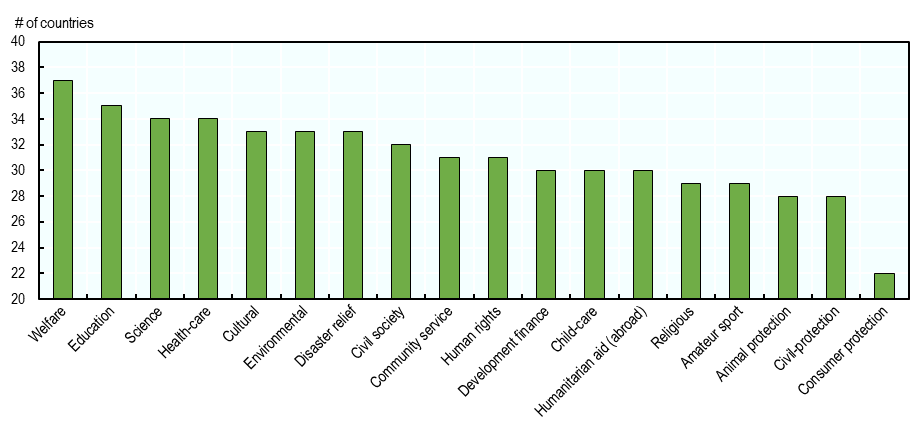
Reassess the activities eligible for tax support: As Figure 1 shows, across the 40 countries surveyed, the activities eligible for tax support are very broad. Countries should ensure that the range of activities eligible for tax support are limited to those areas consistent with their underlying policy goals.
Figure 1. Most common worthy purpose categories that receive tax support
-
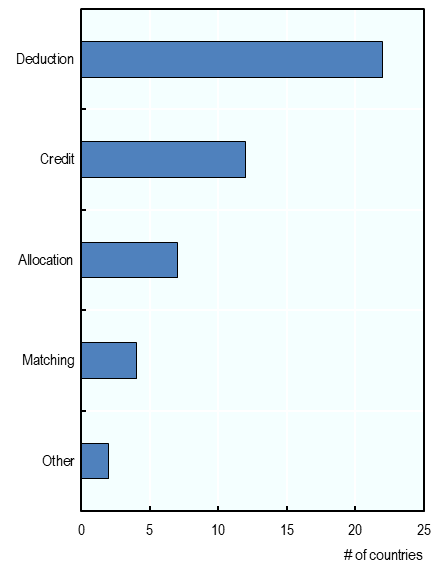
Consider tax credits and fiscal caps. The most popular tax incentive for philanthropic giving, out of the 40 countries included in the report, was a tax deduction (see Figure 2), but this can disproportionately benefit higher income taxpayers. A tax credit coupled with a percentage-based cap may be fairer and more aligned with democratic principles.
Figure 2. Tax incentives for donations by individuals
-
Reassess the extent of tax exemptions for the commercial income of philanthropic entities. Countries could consider exempting income from commercial activities, but only to the extent that they are related to the entity’s worthy purpose. Taxing unrelated commercial income will minimise any competitive disadvantage faced by for-profit businesses.
-
Reduce complexity. Complex tax rules and related compliance costs disproportionately affect low-income donors and smaller philanthropic entities. Countries should look to reduce complexity by, for example, aligning eligibility requirements for tax incentives, simplifying the tax rules for non-monetary donations and facilitating payroll schemes for philanthropic giving.
-
Improve oversight of tax concessions. Increased transparency, such as public registers of approved philanthropic entities, annual reporting, differentiating between donating and sponsoring and publishing tax expenditure data would help safeguard public trust in the sector and ensure that tax concessions used to subsidise philanthropy are not abused through tax avoidance and evasion schemes.
-
Reassess restrictions imposed on cross-border philanthropic activity. Responding to issues such as poverty, environmental concerns and pandemics may require countries and institutions to co-operate across borders. With appropriate checks, equivalent tax treatment could be provided to domestic and cross-border philanthropy.
As these new OECD findings show, there are ways for governments to provide tax support to the philanthropic sector while improving the design of the tax system to maximise effectiveness and social welfare. While there is a case for providing tax support for philanthropy, the fiscal pressures that governments are facing, especially in the context of the COVID-19 crisis, mean that it is even more crucial that this support is directed to where it is needed most.